
The ‘macro diet’ has exploded in popularity as a way to change body composition and support weight management. But what does it actually mean? Let’s break it down—what counting macros is, the pros and cons, how to calculate your own, plus two sample macro-friendly meal plans to show you how it works in real life.
What Is the Macro Diet?
Rather than just counting calories, the macro diet focuses on the amount of each of the macronutrients – typically a certain percent each day.
Essentially, this specific percentage of macros amounts to a caloric range which is ideal for you and your goals. Carbohydrates, protein and fat are the three macronutrients which provide us energy (or calories).
There’s a reason why carbs are the highest percentage when counting macros – carbohydrates are our body’s preferred energy source. Ideally, someone who is correctly counting macros will not restrict carbs altogether but consume more complex carbs.
Complex carbohydrates that are high in fiber can help increase satiety, stabilize blood sugars, promote digestive health, decrease the risk of cardiovascular disease and cancer, decrease cholesterol, and even help with weight loss.
Protein is the macronutrient which takes the longest to digest, also assisting in meal satiety and satisfaction and potentially leading to less overall caloric intake.
Healthy fats are crucial for hormone production, brain function, and the absorption of fat-soluble vitamins. In conclusion, we need all of these “macros” for overall health – how much of each one will depend on each individual.
Pros and Cons to Counting Macros
The Pros
- Counting macros can be a useful strategy in that the focus is more on eating well-balanced, nutrient-dense meals and snacks and less on counting calories. It switches the focus from counting calories to mindfully selecting a meal composed of the three macros.
- Another advantage to the macro diet is the focus on consuming adequate protein – which can promote positive changes in body composition and help preserve lean body mass when in a caloric deficit. Protein has the highest thermic effect, which means it burns the most calories while digesting.
- When compared to counting calories, tracking macronutrients can help to ensure we are adequately meeting our nutrient needs while also identifying areas of improvement.
- Lastly, our fiber needs are more likely to be met by getting a certain percentage of our calories from carbohydrates. Fiber is a vastly underrated nutrient – read more about this here.
Cons of Counting Macros
On the downside, counting your macros can be time-consuming and difficult to maintain. While meal tracking apps can help, trying to meet these percentages may place a lot of stress and attention on counting, measuring and recording your food intake.
This could possibly lead to obsessive or disordered eating. Further, following a strict diet plan can create stress when eating out or in social situations.
If you’re interested in following a macro diet, the hope should be that it increases awareness of macros and what a balanced meal looks like so you don’t have to continue to track them long-term.
Figuring OUt How to Make a Macro Meal Plan
Figuring out your macros depends on a variety of factors: your age, weight, height, physical activity level, and personal goals. There are some calculators online and apps like MyFitnessPal that will calculate this for you.
Determining Your Calorie Needs
First, you will want to figure out your caloric needs. There are four ways our bodies burn calories: at rest (basal metabolic rate), through the thermic effect of food (calories burned as our body digests our food), NEAT (activities of daily living), and through physical activity or working out.
There are numerous BMR formulas that have been developed (over 200!). These formulas give you a rough estimation. They don’t take into account our body fat or lean muscle percentage, and can sometimes overestimate BMR.
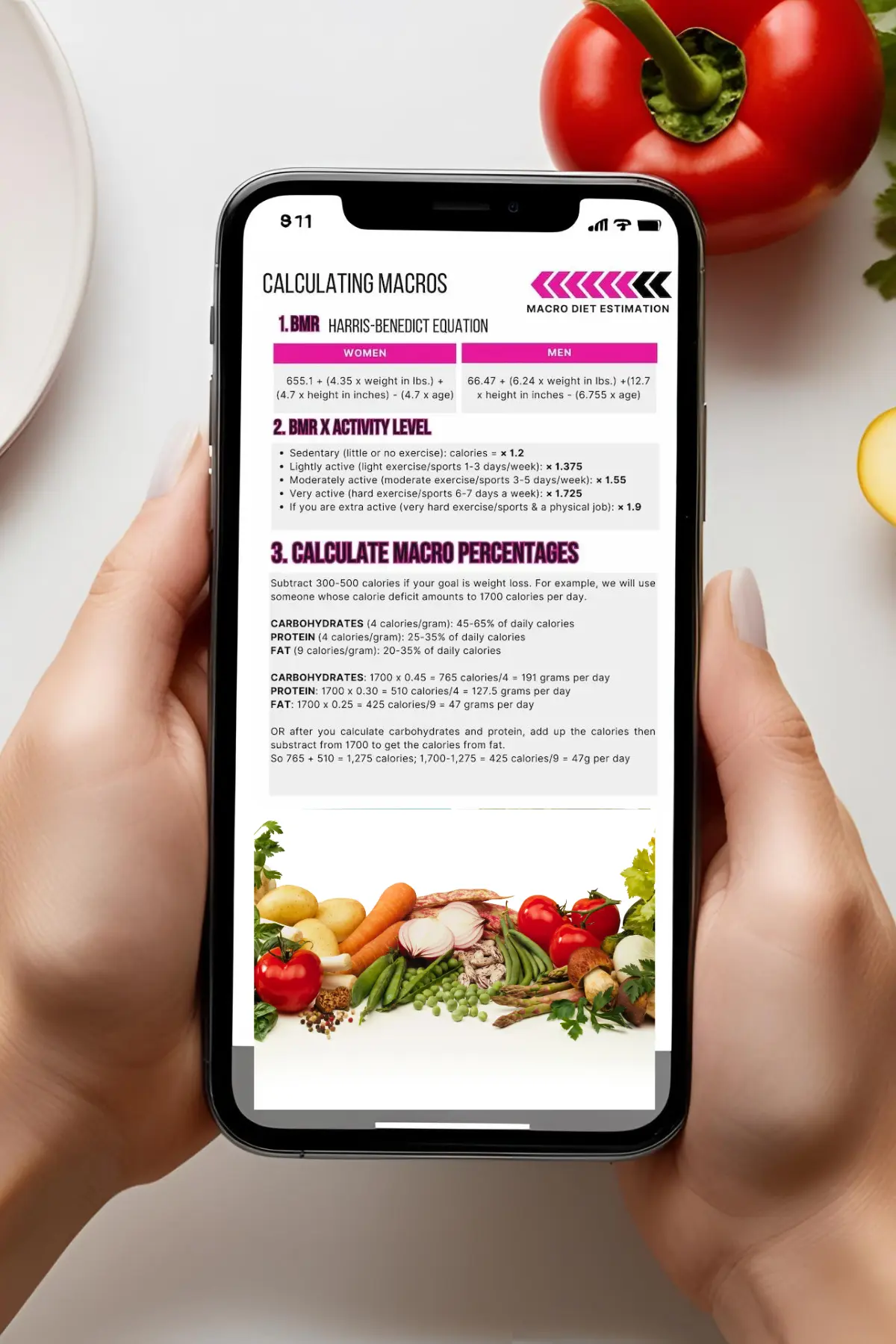
If your goal is weight loss, subtract 300-500 calories from this number. It is never a good idea to consume less than our BMR, as our body needs those calories to function. Even more importantly, it can decrease metabolism and hinder long-term weight loss goals.
Calculating Macros
Below shows a break-down on how to calculate your macros. Of course, you can just find an online calculator to help you out with this or give you an estimate.

While many “macro-friendly” recipes are lower in carbohydrates, I recommend sticking to the lower end if you’re trying to watch your carbs – 45% of your daily calories. Or, at least focusing more on reaching a higher daily fiber intake.
Sample Macro Meal Plans
Here is are two sample macro meal plans with an approximation of nutritional information.
Note: this is just an estimation and individual ingredients and preparation can cause discrepancies.
1700 Calorie Meal Plan #1 (190g carbs, 109g protein, 56g fat)
Using the estimation above, here is a sample of what that would look like for a female who requires 1700 calories per day.
Breakfast
Banana Cinnamon Overnight Oats; 385 calories, 48g carbs, 30g protein, 10g fat

Lunch
4 oz. Grilled Chicken, 1/2 cup Quinoa, 1/2 cup Diced Potatoes, Mixed Veggies with Olive Oil and Vinegar =
458 calories, 58g carbs, 34g protein, 10g fat
Snack
Apple Slices with Almond Butter (2 Tbsp.)
8 oz. Fat-Free Milk
357 calories, 36g carbs, 15g protein, 17g fat
Dinner
4 oz. Baked Salmon with Butter, Steamed Broccoli (1 cup), Brown Rice (1cup)
500 calories, 48g carbs, 30g protein, 18g fat
2200 Calorie Meal Plan #2 (247g carbs, 138g protein, 73g fat)
Breakfast:
Egg and Cheese Burrito – 2 eggs scrambled with 1/2 cup cottage cheese, 12″ high fiber tortilla, 1/2 avocado
634 calories, 59g carbohydrates, 32g protein, 30g fat
Snack:
1 cup of Garbanzo Beans + 1 cup of Cucumber + Drizzle of Olive Oil and Vinegar
1 cup of Whole Grain Crackers
262 calories, 41g carbs, 11g protein, 6g fat
Lunch:
4 oz. Grilled Chicken Breast Over 1 cup Brown Rice, Mixed Vegetable and Apple Salad and 1 Tbsp. Olive Oil Vinaigrette
600 calories, 70g carbs, 43g protein, 16.5g fat
Dinner:
Buffalo Chicken Pasta (cottage cheese buffalo sauce, chicken, high protein pasta, red peppers)
508 calories, 61g carbs, 48g protein, 8g fat

Snack:
1/2 Banana + 1 Tbsp. Peanut Butter + 1 Tbsp. Hemp Hearts
197 calories, 16g carbs, 4g protein, 13g fat
Best Apps for Tracking Macros
Phew, it is no easy feat counting macros. Here are some of the best apps for tracking:
- MyFitness Pal
- Cronometer
- MyMacros+
- LifeSum
- LoseIt!
Is Tracking Your Macros Necessary?
There are pros and cons to counting your macronutrients, and it might be too tedious and time-consuming for some.
It can, however, help people become more aware of creating well-balanced meals and become more in tune to macronutrients they might not be prioritizing enough.
In my personal opinion, prioritizing protein with complex carbohydrates and healthy fats can be just as beneficial – without all the stress of tracking every single gram you’re eating.
If you’re experienced with tracking macros, what are the tips that work for you?
